Rekey or replace? The short answer
If your locks work smoothly and you like how they look, rekey them. Rekeying changes which key opens the lock and keeps the hardware you already have, so it usually costs less than new locks.
Replace a lock when it's damaged, worn out, the wrong style, or missing a feature you want, such as a keypad. See lock installation for that. If you can't get in right now, start with house lockout.
How rekeying works
Most home locks are pin tumbler locks. Inside the cylinder sit small stacks of pins in different lengths. The right key lifts every stack to the right height, and the cylinder turns.
To rekey, the technician takes the cylinder apart and swaps the bottom pins for a set that matches a new key. The old key now lifts the pins to the wrong heights, so it can no longer turn the lock, however many copies exist.
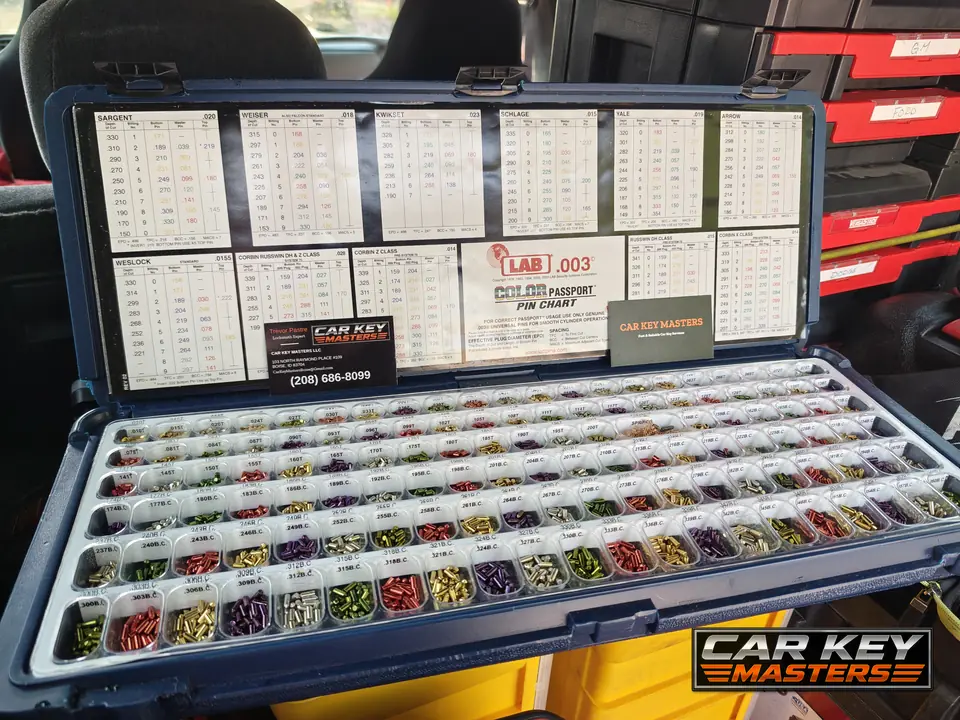
The photo on this page shows the rekey pin kit carried in the service vehicle, with pins in many sizes, so the whole job is done at your door.
When rekeying makes sense
- You just moved in and have no idea how many copies the previous owners, contractors or a realtor's lockbox handed out.
- Keys were lost or stolen, especially with anything that shows your address.
- A roommate or tenant moved out and you're not sure every copy came back.
- Cleaners, dog walkers, contractors or an ex had a key at some point.
- You want one key for every door instead of a full ring.
Don't stop at the front door. A back door, side door or the door from the garage into the house still opens for anyone holding the old key.
One key for every door
Many homes end up with one key for the front, another for the back and a third for the garage entry. When we rekey, we can set all of them to the same new key. Locksmiths call this keying alike.
It works when the locks share a keyway, the shape of the slot the key slides into. A Schlage key won't go into a Kwikset lock, so if your doors mix brands, we'll explain the options, which sometimes means replacing a lock or two.
Schlage, Kwikset, Yale and similar locks
We rekey common residential brands, including Schlage, Kwikset and Yale: knobs, levers, deadbolts and handle sets. Some Kwikset locks use a SmartKey cylinder that rekeys with a special tool instead of loose pins. If you see a small slot next to the keyhole, mention it when you call.
When a lock is too worn to rekey
Rekeying gives a lock a new key, not new parts. A lock that has seen heavy use may need replacing instead. Watch for these signs:
- The key wiggles in the slot or only turns at a certain angle.
- The cylinder spins without moving the bolt or latch.
- The knob or lever is loose and the latch sticks.
- Parts were bent or cracked in a break-in.
If you have to push or pull the door to turn the deadbolt, the cause is often the door lining up badly with the strike plate. We check that first, since a rubbing bolt wears out a new lock, too.
How it works
- Call with the detailsHow many doors, the brand if you know it, and whether you want one key for all. You get a quote by phone.
- ID checkA photo ID with the address, or a lease or utility bill.
- Rekey each cylinderEach cylinder comes out, is re-pinned to the new key and goes back on the door.
- Cut and testNew keys are cut on the spot and tried in every lock before the technician leaves.